Seawolf Shop
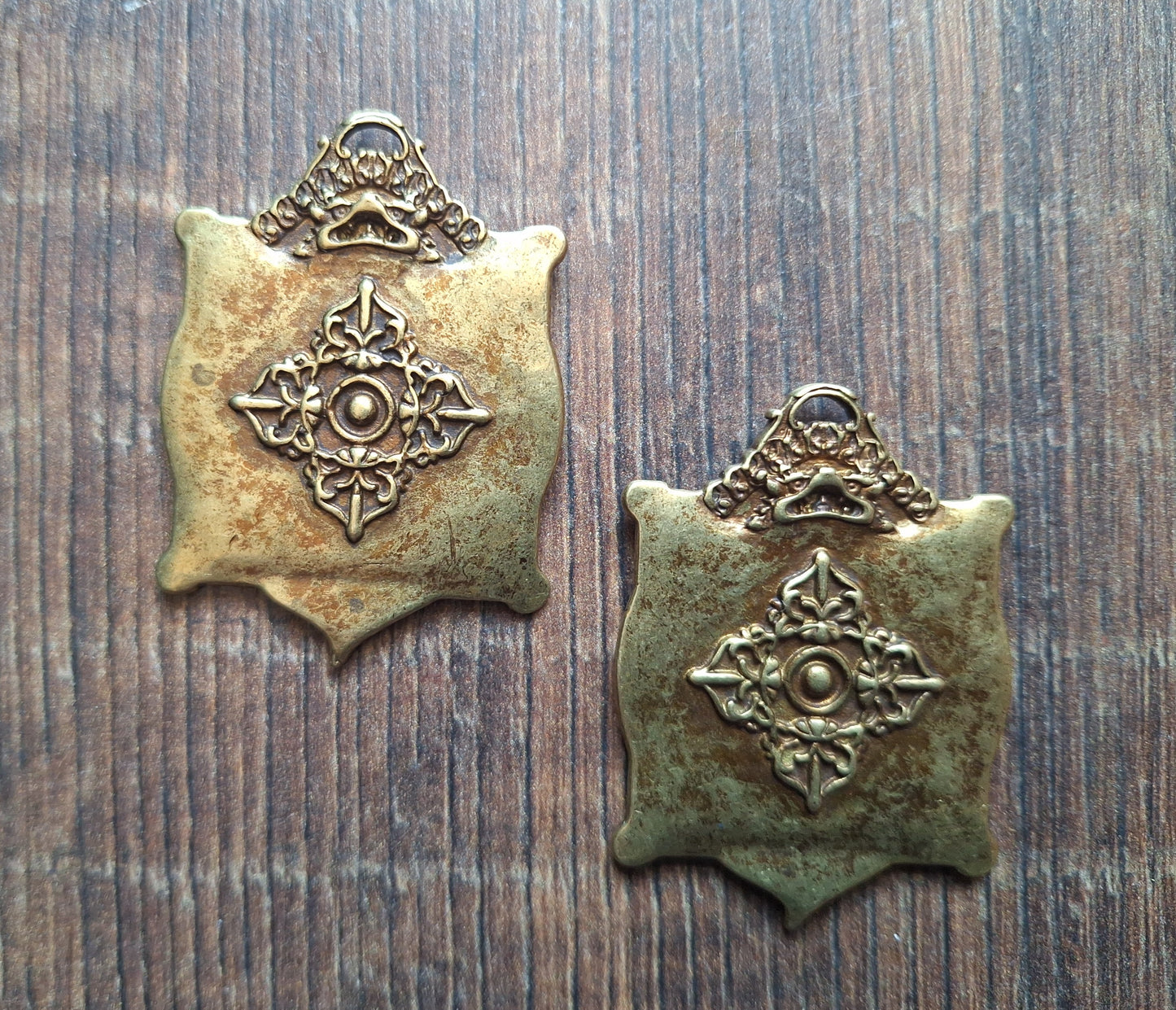
Nepalese melong Rubal with Si Pa Ho and Double Dorje 36 millimeters
Nepalese melong Rubal with Si Pa Ho and Double Dorje 36 millimeters
Couldn't load pickup availability
Share
Recently made brass mirrors from Nepal. In Nepal, mirrors such as these are called 'melong'. They are traditionally often worn on the belt, instead of around the neck.
Sizes; 5,5 centimeters high (measured including the head and tail, and eyelet) and 3,9 centimeters wide (measured including the limbs). Weight is 20 grams.
Recently made, but with a nice vintage-look. Multiple ones available. If you order one, we will handpick one at random for you.
Design characteristics:
These melongs have been made in the shape of the mythical giant Golden Tortoise Rubal. According to legend, Rubal, risen from the depths of the primordial ocean, was shot by the boddhisattva Manjushri with his arrow of immortality. Manjushri inscribed upon Rubal’s belly the astrological teachings for the benefit of mankind with various diagrams. This chart, known as Si Pa Ho, is nowadays mostly understood to be a protective mandala and as such can be seen on many different objects, such as thangka’s and amulets.
Rubal himself also adds to the protective dynamics of such an item, being portrait as a wrathful protector deity, often in flames and with demonic features.
The astrological chart of Si Pa Ho on the belly of Rubal consists of three schematic images:
1) In the center the mystical square Me Wa Gu can be seen. In the 9 parts the numbers from 1 to 9 are inscribed, the sum of which in each column is 15. This scheme forms in Tibetan-Mongolian astrology a numerological indication of the relationship between a person and deities and spirits. Each digit governs the year, they replace each other in reverse order.
In China this mystical square has been known since 2200 BCE and is called 'Lo Shu' or Nine Halls diagram; it derives from ancient Chinese mathematical and divination traditions, such as the art of Taoist Geomancy. Nowadays it is also widely known as an important emblem in Feng Shui; the 9 parts (also called 'palaces') then represent the 8 directions of the compass plus the central position, with each part having its own energy.
2) In the ring around the square the 8 trigrams ('Ba Gua') of Par Ha Ge can be seen. The trigram symbols come from very ancient origin; they derive from symbols found on ancient Chinese divination bones dating back as long as 11th century BCE. A related version of bone oracle is still used today by Turkic and Mongolian people, and also in the lineage of Spirit of Wolf Shamanism; 'Khaziki'.
Doubled trigrams form 64 hexagrams, which form the core of the I Ching, the Book of Changes.
Each trigram is a divinatory grapheme and represents different dynamics, energies, cardinal points, animals, seasons etc. In depictions such as on these melongs, where the 8 of them together form a circle, it symbolizes heavenly order, a healthy balance and right flow of energy.
3) In the outside circle the 12 animals from the Eastern zodiac can be seen. Just like the circular arrangement of the trigrams, also this motive adds to the idea of heavenly order. But also its presence, when used on shamanic mirrors, symbolizes control over time and space, an important core principle in the practice of shamanism.
The backside of the melong shows the symbol of the Double Dorje. The double dorje or crossed dorje (or in Sanskrit; visvavajra) is a symbol very common in Buddhism and Hinduism. It shows dorje-heads going into all four cardinal directions from the central hub, which symbolizes the principle of absolute stability, of finding solid ground in the middle of the universe.
It is said that a vast crossed dorje underlies Mount Meru, the esoteric mountain in Hindu and Buddhist cosmology that is considered to be the center and axis of all worlds, both inside ourselves and outside, and both the physical and non-physical worlds. Thus the double dorje supports the entire universe and also symbolizes a perfect balance between spirit and matter, heaven and earth, wisdom and compassion (the divine feminine and divine masculine).
Being a symbol of indestructability, a double dorje is often depicted as the central hub of intricate mandala representations, such as in thangka’s, where it forms the immoveable support or foundation of the mandala palace. Also the symbol is often found on for example depictions and statues of buddhist deities, ritual attributes, amulets, furniture and fabrics
Read more about the origin, design and usage of (shamanic) mirrors in the general description of our webshop collection "Mirrors and Melongs".