Seawolf Shop
Bronze dorje pendant
Bronze dorje pendant
Couldn't load pickup availability
Share
One of the symbols most common in the iconography of Tibetan Buddhism, is without a doubt the dorje or vajra. It can be seen in the hands of numerous buddhist deities on paintings and in statues, as a symbol on all kinds of ceremonial or household attributes and of course as a ritual attribute on the altar of both professional and lay buddhist practitioners.
The Tibetan word ‘dorje’ consists of two parts; ‘do’ which means ‘stone’ and ‘rje’ which translates as ‘noble’, ‘prince’ or ‘lord’. Overall it can thus be translated as ‘noble stone’ or ‘Lord of the Stones’.
The Sanskrit word for it is ‘vajra’, which translates both as 'lightning bolt' and as 'diamond'.
In Tibetan Buddhist practice, the dorje commonly forms a ritual pair with the bell (‘ghanta’). In this combination, the dorje is traditionally held in the right hand. Items held in the right hand in Tibetan Buddhist practice, symbolize the masculine principle of compassion-in-action; skilful action to accomplish compassionate intents.
The dorje is such an active attribute. It has the indestructible properties of a diamond and the force of a thunderbolt. It supports in (to state it quite simple) cutting through the crap of the mind; finding a clear path through the diversions of the 'monkey-mind' and ego-chatter, seeing what's real and what's not. The dorje is said to destroy all kinds of ignorance and in this way helps in gaining true insights.
A dorje can be used both in personal meditative practices as in work with clients or participants. In the latter settings it can for example be used as an instrument to receive, distribute and channel energies or as a space-holding attribute, to support both the practitioner/shaman and the participants in keeping a clear focus and not getting caught in mental distractions.
When looking at a dorje, it is filled with symbolism. Starting from the center you see:
· A small sphere or globe; representing the underlying nature of the universe, the sphere of the actual reality of Emptiness. This sphere is said to contain the seed mantra (‘bija’) Hum. Sometimes this syllable is inscribed on this central sphere, sometimes visualized.
· Three rings surrounding the sphere on each side; symbolizing the three-fold bliss of Buddha nature.
· Two lotus flowers consisting of eight petals; they are similar in depiction, but when the dorje is held upright during practice, there is of course one above and one below the central sphere. The lower one is then representing samsara and the upper one is representing nirvana. Or also; the eight petals of the upper flower represent the Eight Bodhisattvas and the eight petals of the lower flower represent their female consorts.
· On top of these lotus-thrones a thin flat slice represent a moon disc, on which the pronges sprout forth, sometimes from the mouth of makara’s, the mythical watermonsters symbolizing fierce activity, sometimes from elongated lotus petals.
· There can be variation in how many pronges a dorje has. The most common number, which can also be seen in this dorje, is five (also the central axis is counted as a pronge). There are multiple explanations for the symbolism of the five pronges, but a common one is that of the five male ‘perfections’ (generosity, morality, patience, perseverance and concentration, reflected in the personification of the five Wisdom Buddha’s) on the one side and their five feminine consorts on the other side.
· The pronges close at the top, their coming together symbolizing the perfection of the method of active compassion.
· The pronges come together in a tip which is sometimes shaped like a four-faceted jewel, representing Mount Meru as the center and axis of both the outer and inner worlds.
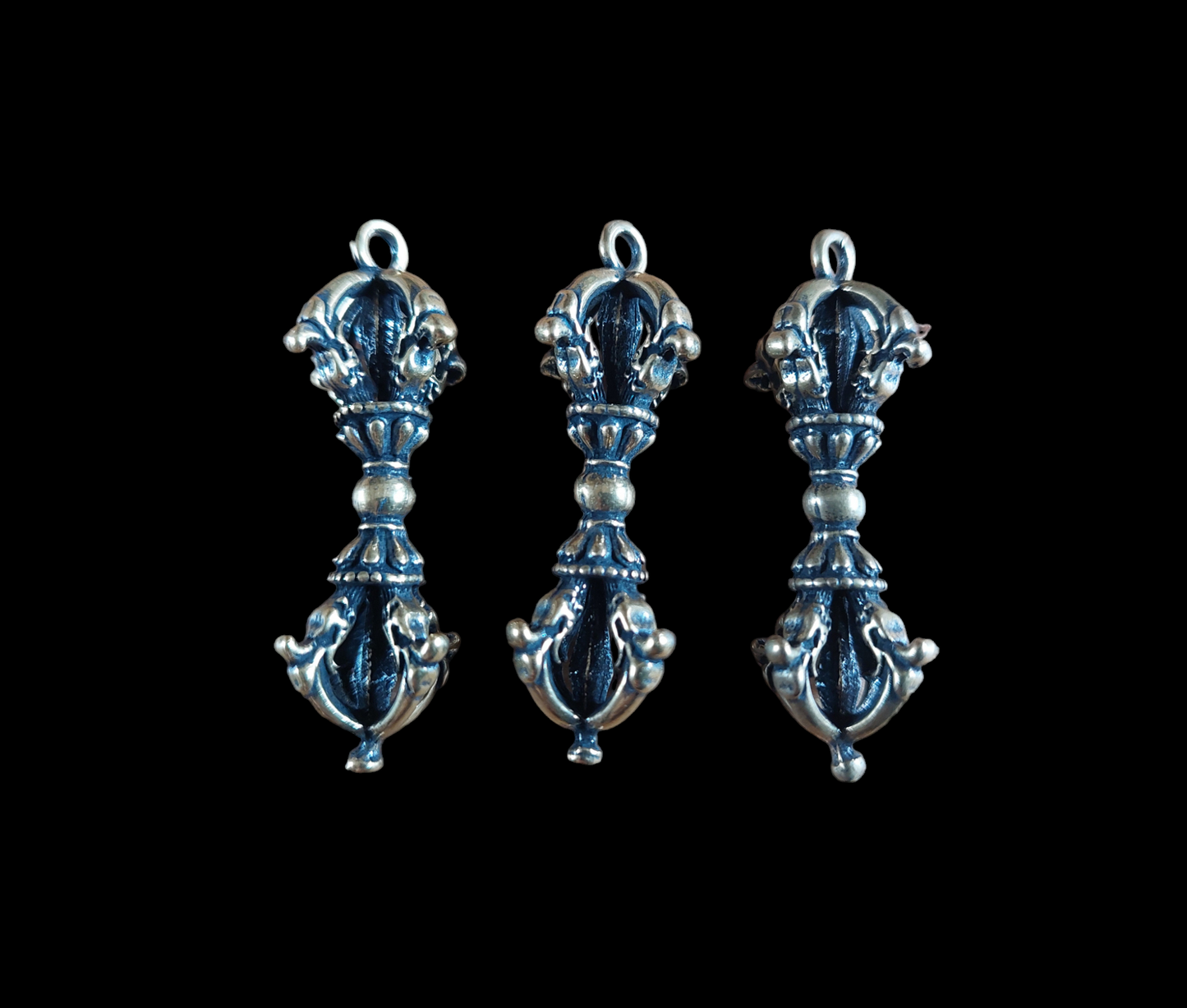
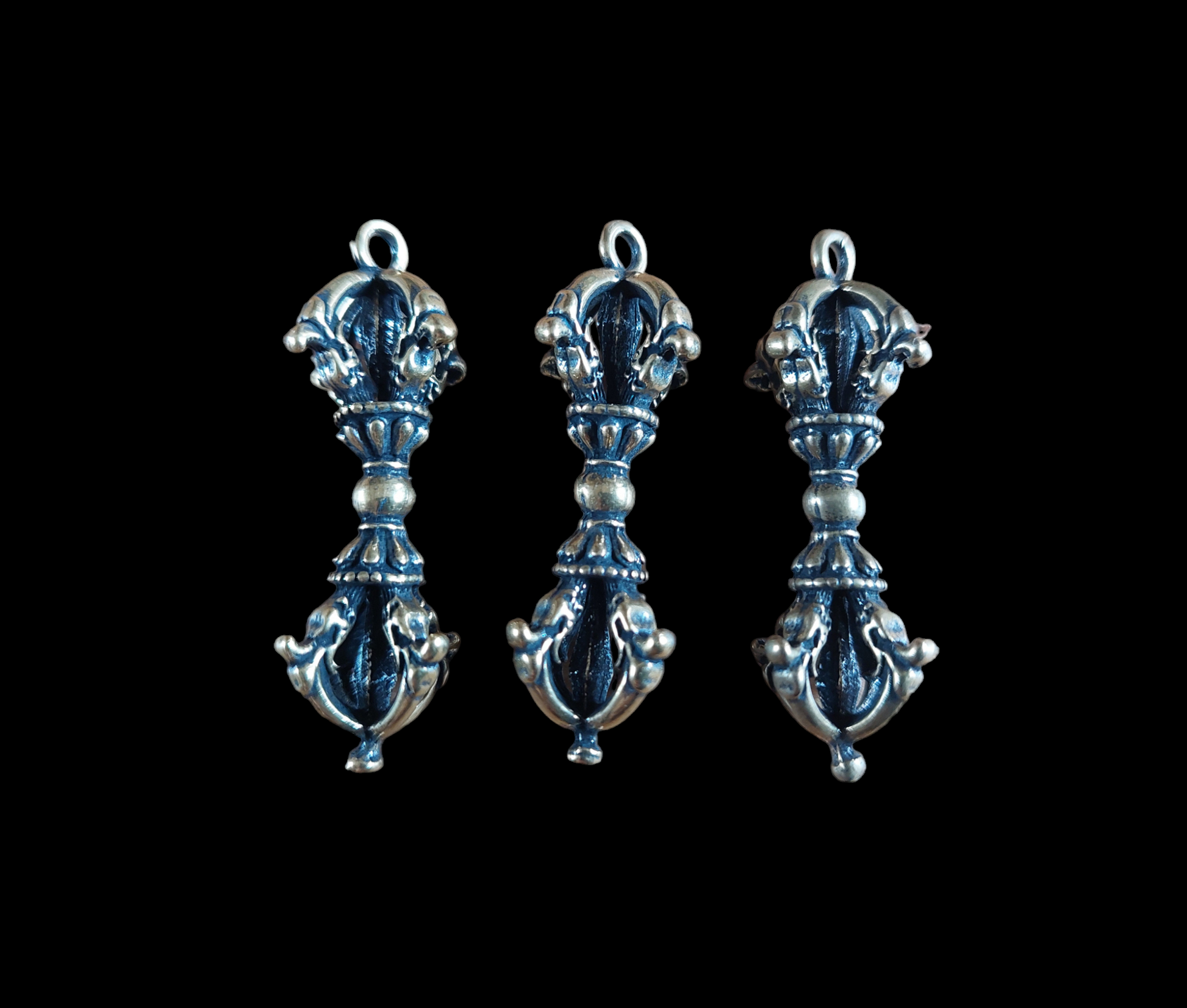
These nice little dorje pendants are made of bronze and come from Tibet. They measure approximately 4 centimeters length (without eyelet) and weigh 8 grams each.
Hang these dorje pendants on a simple cord or necklace to use as a personal amulet or use them in your personal crafting purposes.
Multiple ones available, sold per piece.