Tax included.
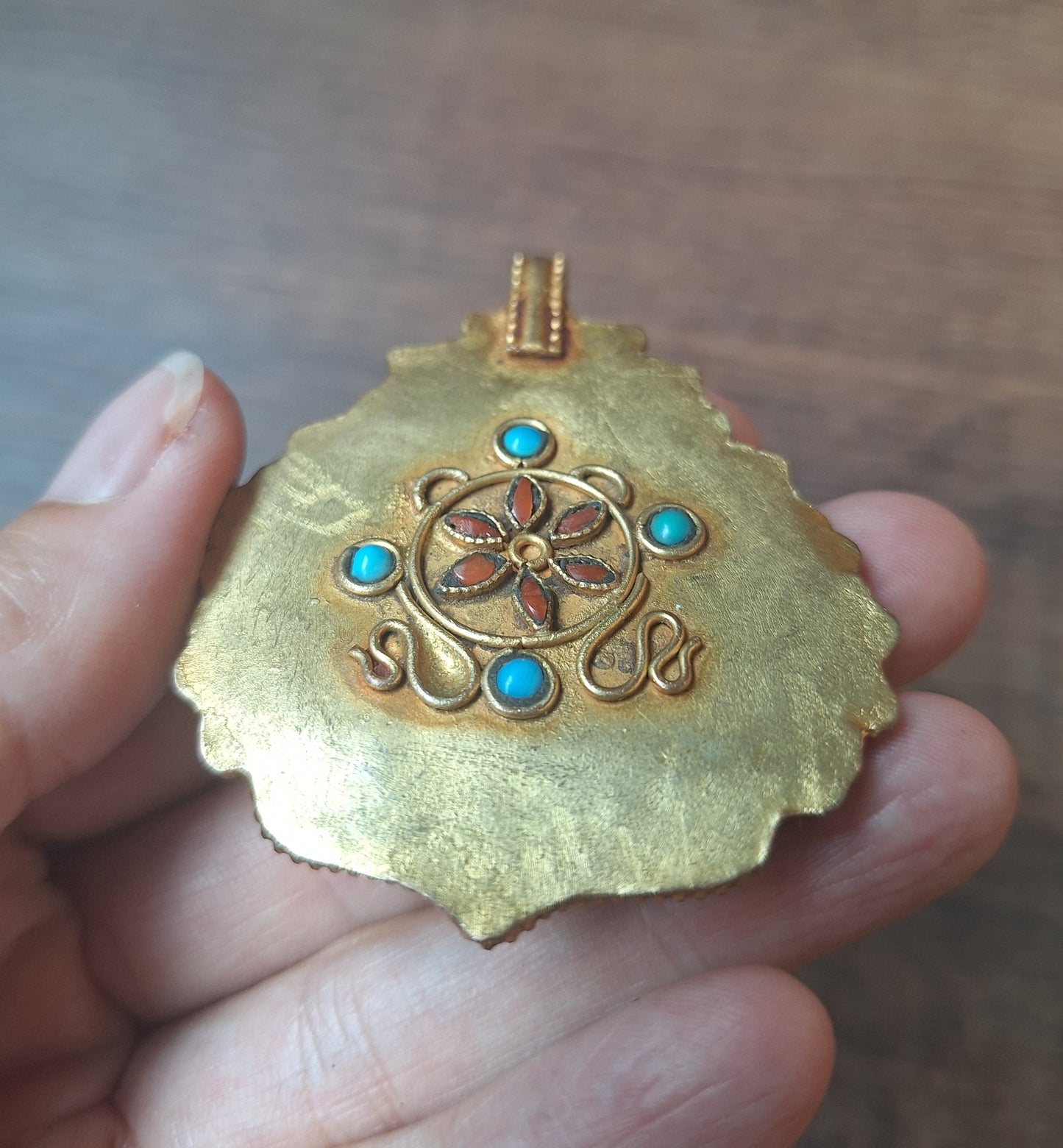
Very beautiful gilded copper filigree pendant with the depiction of Amitabha Buddha, handcarved in (real) coral and turquoise. The style in which the pendant is representative for the Newari tribe and is an excellent example of artisan Himalayan craftmanship.
Amitabha, also known as Amida or Amitayus, is one of the five dhyani (primordial) buddha's in Mahayana Buddhism and the central buddha figure in the Pure Land teachings, known in both Eastern Asian and Tibetan Buddhism.
After renouncing the royal lineage which he was born in, he spent the rest of his human life as a monk known as Dharmakara. On his path to buddha-hood he swore 48 oaths, promising to assist every other human being with an honest wish to reach enlightenment. His oaths speak for example of the promise to ensure rebirth in Sukhavati, a state of consciousness also known as the "Western Paradise" or “the Land of Ultimate Bliss" to anyone calling upon him sincerely and faithfully (for example by reciting his name with the mantra "Om Ah Amitabha Hum"), and to always appear to those calling his name on their death-bed.
This extraordinary pendant features a depiction of Amitabha carved in (real) coral. The red color is actually a common part of his iconography; it symbolizes unconditional love, warmth, and the powerful energy of compassion. Also it is connected with the Fire element, with its ability to purify, transform and strengthen. Amitabha is shown sitting on a lotus throne, holding a Long Life vase in his hands.
The gilded copper is meticulously decorated with filigree work and pieces of (carved) turquoise and coral. It is approximately 6,5 centimeters high (including the eyelet) and 5,3 centimeters wide and weighs 36 grams.
Unique piece, only one available. And please know; the art of real, artisan stone- and coral carving by hand is a dying craft in Himalayan area's, because of, among other reasons, unfair competition from machine-made, a dime-a-dozen, mass production in other Asian regions. Therefore real pieces such as this one are getting increasingly more rare and expensive.