Seawolf Shop
Old Nepalese melong Kali en Si Pa Ho 43 millimeters
Old Nepalese melong Kali en Si Pa Ho 43 millimeters
Couldn't load pickup availability
Share
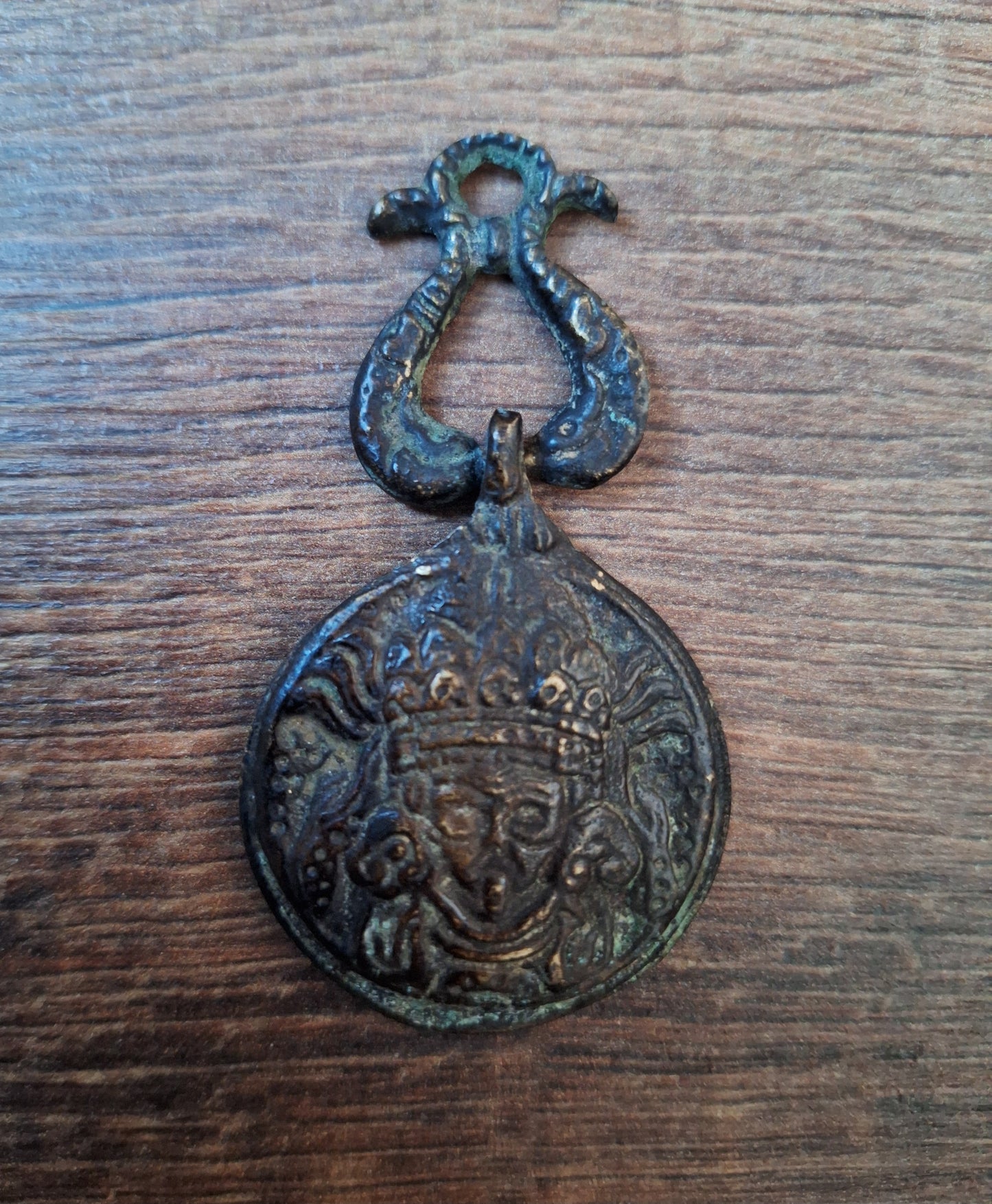
Old bronze mirrors from Nepal with a diameter of 43 millimeters (measured without the eyelet). In Nepal, mirrors such as these are called 'melong'. They are traditionally often worn on the belt, instead of around the neck.
These melongs are good quality ones, made from a heavy quality bronze, which has gained a nice dark layer of patina over time. They are decorated on both sides:
The front side shows a depiction of the great goddess Kali, one of the major deities in the Hindu pantheon. She is worshipped all over India and Nepal in multiple schools and traditions. According to a 6th century CE Hindu mythological sacred text known as Devi Mahatmyam, Kali was born in a moment of intense crisis. The goddess Durga, in herself already a very fierce manifestation of the Great Mother Goddess Shakti/Parvati, manifested her rage in the personification of Kali to destroy the demons Madhu and Kaitabha (‘chaos’ and ‘ignorance’), who threatened the world. Without hesitating, Kali leaped into battle and easily destroyed the demons.
At first glance, her figure might appear quite a complex and confusing one, with her being worshipped in such a wide variety of characters. From a terrifying, fierceful warrior to a loving, nurturing mother. From a goddess of time, death and destruction to a protector and guide on the path to enlightenment.
And yet, of course, if you look deeper into it, all these aspects are ultimately related to each other. Kali is the ultimate embodiment of the Divine Feminine. She is everything at once, the boundless energy of the universe and the primal force of nature. She teaches about being fearless in confronting and overcoming our attachments, fears and obstacles, thus leading the ones devoted to her to transcend the limitations of our ego and find profound spiritual transformation.
On the backside, a depiction of the traditional Tibetan astrological system can be seen; the astrological chart of Si Pa Ho, consisting of three schematic images:
1) In the center the mystical square Me Wa Gu can be seen. In the 9 parts the numbers from 1 to 9 are inscribed, the sum of which in each column is 15. This scheme forms in Tibetan-Mongolian astrology a numerological indication of the relationship between a person and deities and spirits. Each digit governs the year, they replace each other in reverse order.
In China this mystical square has been known since 2200 BCE and is called 'Lo Shu' or Nine Halls diagram; it derives from ancient Chinese mathematical and divination traditions, such as the art of Taoist Geomancy. Nowadays it is also widely known as an important emblem in Feng Shui; the 9 parts (also called 'palaces') then represent the 8 directions of the compass plus the central position, with each part having its own energy.
2) In the ring around the square the 8 trigrams ('Ba Gua') of Par Ha Ge can be seen. The trigram symbols come from very ancient origin; they derive from symbols found on ancient Chinese divination bones dating back as long as 11th century BCE. A related version of bone oracle is still used today by Turkic and Mongolian people, and also in the lineage of Spirit of Wolf Shamanism; 'Khaziki'.
Doubled trigrams form 64 hexagrams, which form the core of the I Ching, the Book of Changes.
Each trigram is a divinatory grapheme and represents different dynamics, energies, cardinal points, animals, seasons etc. In depictions such as on these mirrors, where the 8 of them together form a circle, it symbolizes heavenly order, a healthy balance and right flow of energy.
3) In the outer ring the 12 animals of the eastern zodiac can be seen. Just like the circular arrangement of the trigrams, also this motive adds to the idea of heavenly order. But also its presence, when used on shamanic mirrors, symbolizes control over time and space, an important core principle in the practice of shamanism.
There are two melongs available, similar in style and decoration, but slightly different in weight: #1 (left on the picture) weighs 54 grams, #2 (right on the picture) weighs 44 grams.
Sold per piece, you can choose your favorite one via the selection-menu.
Read more about the origin, design and usage of (shamanic) mirrors in the general description of our webshop collection "Mirrors and Melongs".