Seawolf Shop
Vintage Nepalese shamanic rudraksha necklace #17
Vintage Nepalese shamanic rudraksha necklace #17
Couldn't load pickup availability
Share
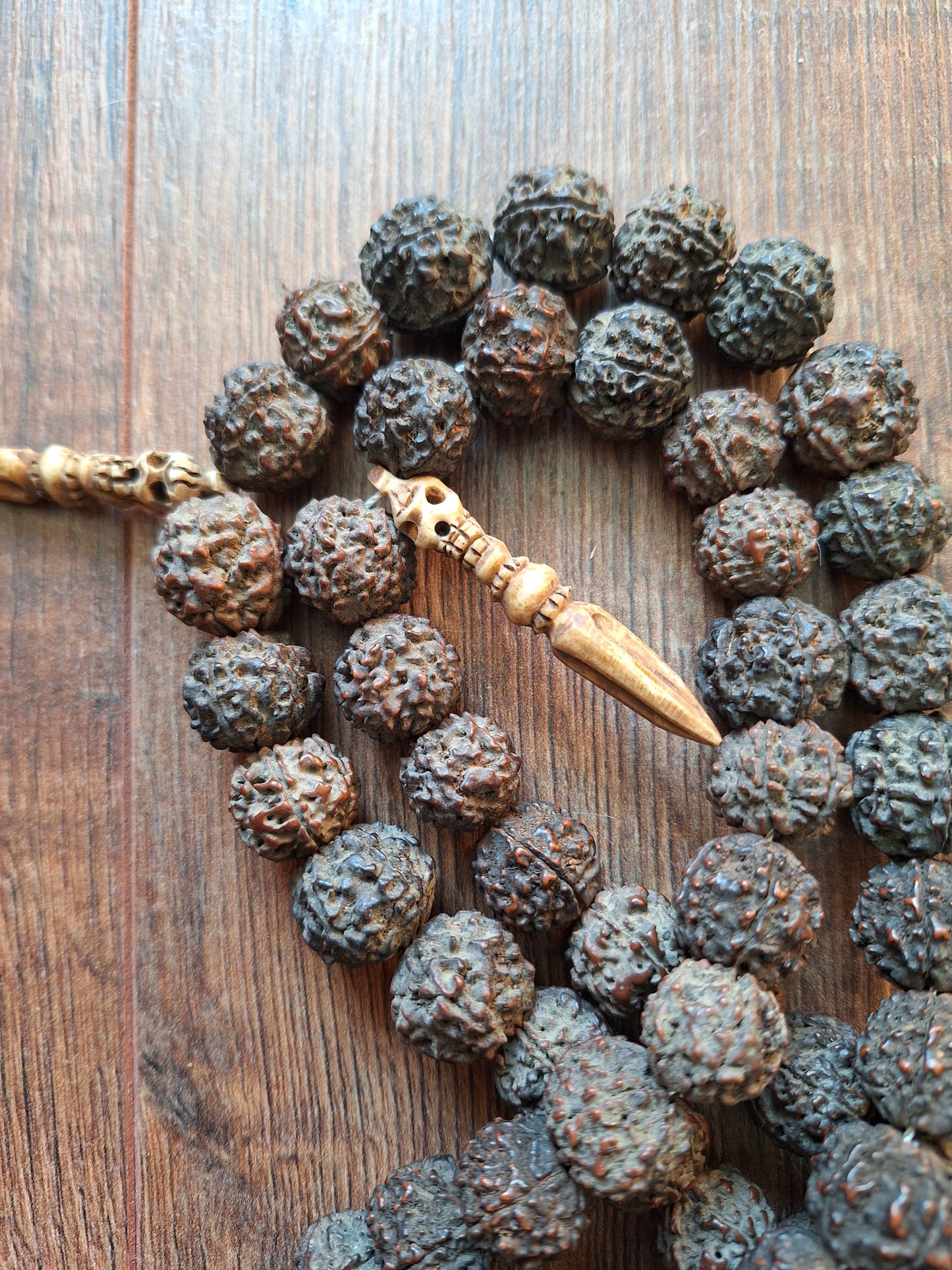
Vintage shamanic rudraksha necklace from Nepal. Has been used in ceremony before.
Rudraksha beads are categorized by the number of faces/facets that can be distinguished on the surface. These are called 'mukhi'. In this necklace, 5 mukhi beads have been used. The 5 faced rudraksha bead is the most commonly used type, it represents the five forms of Lord Shiva himself. The 5 mukhi rudraksha helps in awakening one's higher self and from there the personal connection to the divine. Also, 5 mukhi rudraksha beads have a special affinity for the 5th chakra, the Visshudha or throat chakra.
In total 54 rudraksha beads, with a diameter of approximately 15 millimeters each, are used. These beads have become very dark over time, some are even almost black, which is also said to have increased their power; most rudraksha beads turn naturally darker over time, so the longer they have ripened the darker they have become. And in this ripening process, over time they have gained a lot of natural energy.
On this necklace, two small phurba pendants handcarved from yak bone have been attached.
The phurba is a ritual triangular knife common in vast territories of Asia, including India, Pakistan, Nepal, Tibet and Mongolia. Read all about the phurba's usage, design and symbolism in the description of our webshop collection "Ritual Attributes; Phurba's".
These phurba pendants show a depiction of a human skull at the pommel, a symbol very prominent in Himalayan regions influenced by Tibetan buddhism.
On the one hand it can be said that the symbol of the skull (of course) refers to death; it is a powerful reminder of the fact that all our lives will simply end one day. The symbol of the skull is thus used in all kinds of meditative practices to contemplate on this inevitabilty and also on the other side of this medal; how important it is to live your life in the best possible and most compassionate of ways.
On a more metaphorical level, contemplating on the image of the skull also is a powerful practice in cutting through the bonds with one's own ego and the identification with the physical body. It takes us to the limits of human knowledge and helps to gain insight in the buddhist concept of 'Emptiness', which doesn't mean 'nothing-ness', but actually quite on the contrary refers to the true nature of the universe and reality; the endless, ultimate emptiness in which all possibilities exist.
Human skulls are also very prominent in the iconography around a lot of the 'wrathful' deities in Tibetan Buddhism and Hinduism. Wrathful deities are the fierce, forceful aspects or manifestations of Buddhas, Bodhisattvas or Devas. They are often portrait as terrifying, demonic looking beings adorned with human skulls or bone ornaments and ritual weapons. In this setting, the human skulls symbolize all the poisonous delusions and limiting mental beliefs that need to be overcome on the path to enlightenment.
Each phurba pendant is approximately 6 centimeters long.
Also a bronze bell has been added to the necklace. Its high vibrational sounds help to purify the energy during the ritual by driving away the evil spirits and calling in the helpful ones. This bell has a diameter of approximately 3,5 centimeters and a height of approximately 4,5 centimeters (measured without the eyelet).
Total length of this necklace is approximately 88 centimeters.
Unique item, only one available.