Seawolf Shop
Vintage bronze khatvanga's, small size
Vintage bronze khatvanga's, small size
Couldn't load pickup availability
Share
A khatvanga is a ritual or ceremonial staff or staff-weapon known in Hinduism and Buddhism, especially in Tantric traditions such as Shaivism and Vajrayana. The form is derived from the typical emblematic staff, worn as an attribute by early Indian Shaivite ascetics called Kapalika. 'Kapalika' translates as 'skull-men' or 'skull-bearers', referring to the fact that these men (originally penitents, who got sentenced to twelve years of penence after killing a Brahmin) traditionally carried a skull-topped trident and a human skull as begging bowl.
Early tantric Buddhists adopted the attributes of these Kapalika into their spiritual practices and thus the khatvanga became more and more of a ceremonial or ritual attribute, where the original Kapalika symbolism got mixed more and more with Buddhist symbolism.
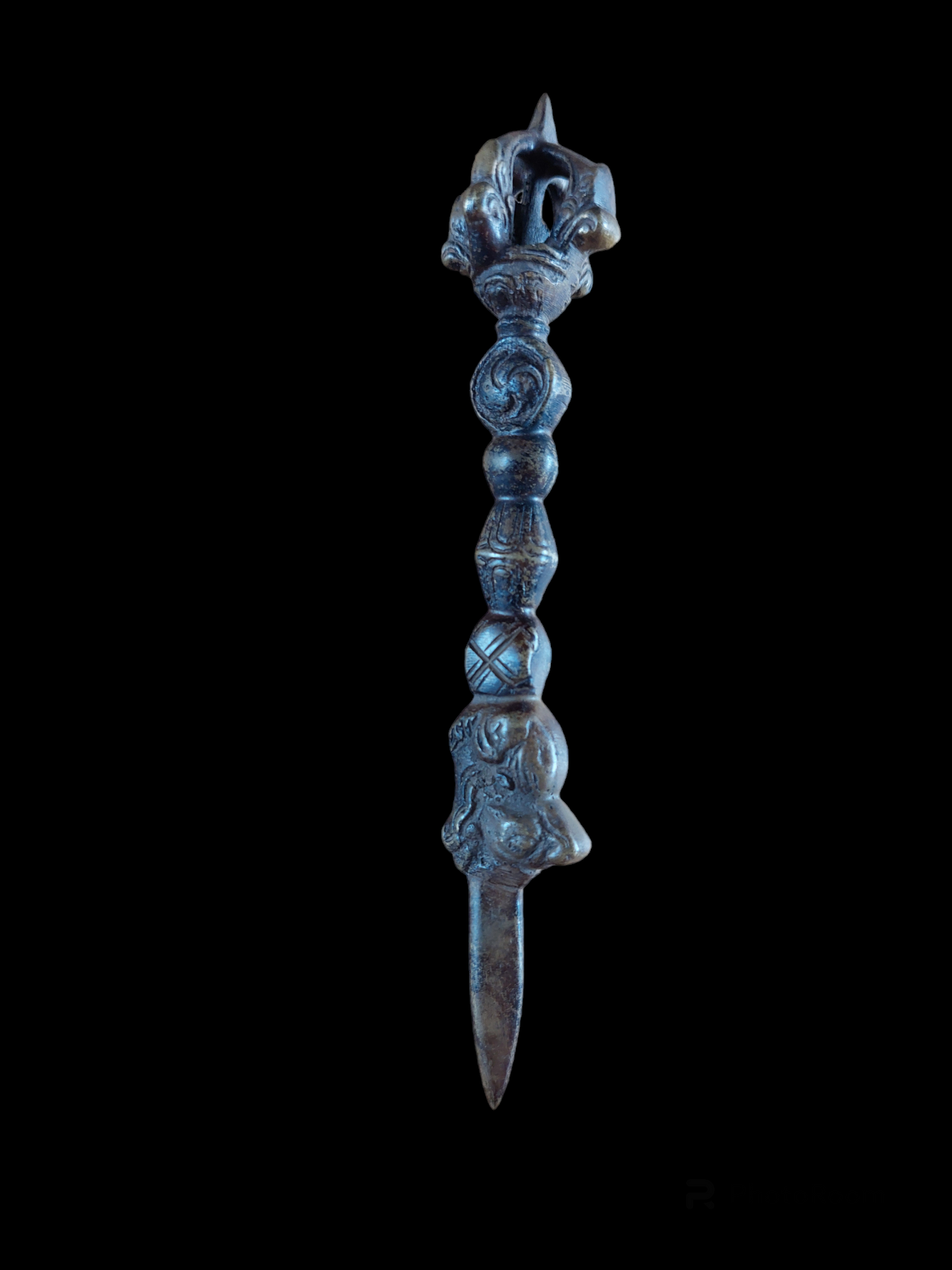
These pictures show two somewhat smaller sized khatvanga's, easy to take with you when travelling for example, or even to be used as a personal amulet:
#1 (left on the picture); a very simple style, consisting of only a staff with a dorje top. This one could probably better be described as a 'danda', the yogic ritual staff. Approximately 14 centimeters long and 52 grams.
#2 (right on the picture); more reminiscent in style of the early Kapalika staff-weapons. This one shows for example a phurba-tip sprouting from the jaws of a Makara (a mythical watermonster symbolizing fierce activity) and a dorje on top. Approximately 13 centimeters long and 68 grams.
The symbol of a dorje or double dorje is one of the symbols most common in the iconography of Tibetan Buddhism. The Tibetan word ‘dorje’ consists of two parts; ‘do’ which means ‘stone’ and ‘rje’ which translates as ‘noble’, ‘prince’ or ‘lord’. Overall it can thus be translated as ‘noble stone’ or ‘Lord of the Stones’. The Sanskrit word for it is ‘vajra’, which translates both as 'lightning bolt' and as 'diamond'.
In Tibetan Buddhist practice, the dorje commonly forms a ritual pair with the bell (‘ghanta’). In this combination, the dorje is traditionally held in the right hand. Items held in the right hand in Tibetan Buddhist practice, symbolize the masculine principle of compassion-in-action; skilful action to accomplish compassionate intents.
The dorje is such an active attribute. It has the indestructible properties of a diamond and the force of a thunderbolt. It supports in (to state it quite simple) cutting through the crap of the mind; finding a clear path through the diversions of the 'monkey-mind' and ego-chatter, seeing what's real and what's not. The dorje is said to destroy all kinds of ignorance and in this way helps in gaining true insights.
These khatvanga's are made of bronze and from vintage origin. The bronze has gained a nice dark color over time. Being from vintage origin, they might show some small signs of their age and previous usage, but overall they are in good condition.
Sold per piece, you can choose your favorite one via the selection-menu.