Seawolf Shop
Tibetan buddhist bell and dorje set
Tibetan buddhist bell and dorje set
Couldn't load pickup availability
Share
When looking at depictions of Tibetan Buddhist deities, there are often ritual attributes to be seen in their hands, ranging from one or two, to many at the same time (depending on the number of arms the deity is displaying). Overall it can be said that the attributes held in the left hand(s) are related to the (feminine) principles of wisdom and the realization of the emptiness of all phenomena and the items held in the right hand(s) are related to the (masculine) principles of skillfull means and compassion-in-action. The combination of both principles as shown by the items in the left and right hands, is an inseparable one on the path to enlightenment.
Many of such items from the iconography of the buddhist deities, can also be implemented in one's own spiritual practices. A common pair of ritual attributes found in Tibetan Buddhist practice is that of the bell and dorje.
When used together, the bell is held in the left hand and the dorje in the right hand. The bell thus symbolizes the feminine principle of wisdom, or in this case more specifically; the sound of the bell echoes the sound of Emptiness or Shunyata. The dorje represents the masculine principle of active compassion. Wisdom and compassion, emptiness and form - they are inseparable.
When not in use, the bell and dorje can be placed either on the altar (very close to each other, or even better; touching each other, symbolizing that the principles they represent should always be in union, not only during practice) or out of sight in their storage pouches (from the, maybe somewhat old-school, traditional idea that the tantric practices which they are part of, are to be kept secret for casual passing-by outsiders).
This bell & dorje set has been recently made in Nepal. It has been used by one practitioner before for a short time, but is still in 'as new' condition and ready for its next work.
As is common, the bell itself is made of a traditional metal alloy (containing different metals like cadmium, lead, copper, zinc, nickel, chromium and manganese) in very specific relative proportions, giving it a distinct sound and vibration. These sounds are considered 'auspicious sounds' and are related to the sound 'Aum', the all encompassing cosmic vibration of the universe.
The handle of the bell is made of brass, which has been goldpainted. The use of goldpaint on sacred items such as ritual attributes, statues of deities and thangka paintings, is something that can often be seen in (especially) Tibetan Buddhism. The golden color is associated with purity, enlightenment and the principle of 'dharmakaya' (the ultimate truth or reality). It is said that the skin of fully enlightened buddha's shines with a radiant golden light. Also there is a connection with the qualities of the sun. Offering light and warmth to everyone without distinction mirrors the principle of 'karuna'; universal compassion.
The bell is 15 centimeters high and 8 centimeters in diameter. It weighs 295 grams and has a steel clapper.
Also the accompanying dorje has been made of goldpainted brass. It has a length of 10,5 centimeters and weighs 103 grams.
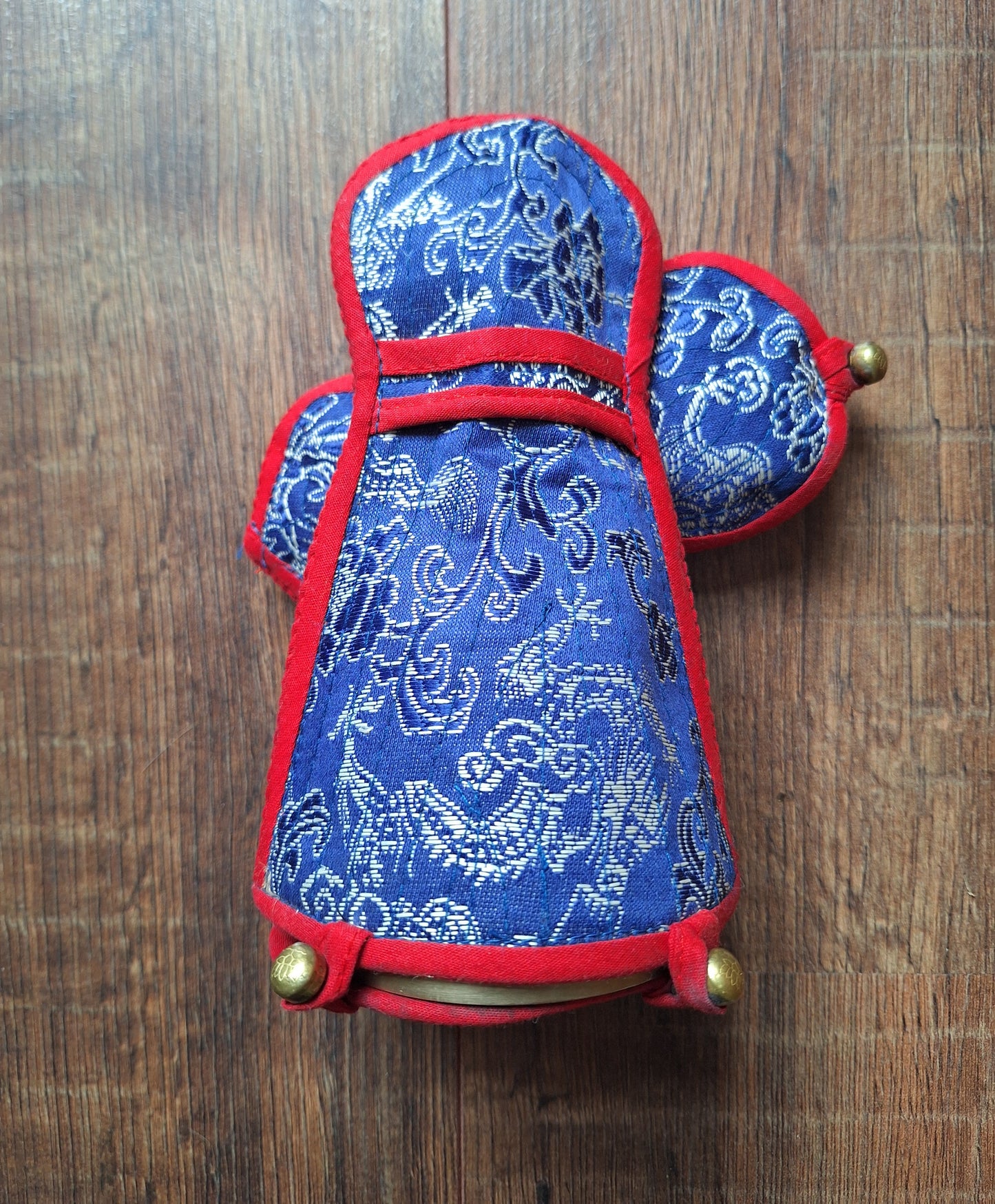
The bell and dorje come in a pouch of cotton brocade in a blue color with silver motives and a red lining. The pouches close with brass buttons with a lotus design.
Only one set available.
Some extra info on the design of the bell:
This altar bell has been made in a common Tibetan Buddhist style and is very rich is symbolism. In Tibetan Buddhist practice, a bell such as this is called ‘ghanta’ and commonly forms a pair with a dorje. In that combination, the bell should be held in the left hand and symbolizes the feminine principle of wisdom, as personified by the Great Mother goddess Prajnaparamita. The bell as a whole, with all the traditional depictions on it, can be seen as the mandala of Prajnaparamita:
The hollow of the bell represents the emptiness from which all phenomena arise, the clapper represents form. The sound they create together radiates forth from the void, lingers for a while, and then disappears back into emptiness again.
Close to the rim, a ring of dorjes can be seen; an indestructible circle of protection.
Above this protective border, approximately half way the bell, a depiction of Makaras holding loops of jeweled pendants in between more dorje symbols can be seen. The jeweled pendants symbolize the decoration of the heavenly palace and the dorje’s in this area represent the eight charnel grounds of the mandala. In between the Makaras, eight lotus petals represent the Eight Bodhisattvas.
And at the top of the bell, yet another row of dorjes symbolizes the inner walls and inner protection circle of the mandala.
Also the handle of the bell is filled with symbolism; the face is that of the Great Mother Prajnaparamita. The shapes in the stem below her represent the earth and a vase of treasures. Above the face of the Mother, a lotus pedestal forms the base for the crown of a five-pronged dorje.
Some extra info on the design on the dorje:
One of the symbols most common in the iconography of Tibetan Buddhism, is without a doubt the dorje or vajra. It can be seen in the hands of numerous buddhist deities on paintings and in statues, as a symbol on all kinds of ceremonial or household attributes and of course as a ritual attribute on the altar of both professional and lay buddhist practitioners.
The Tibetan word ‘dorje’ consists of two parts; ‘do’ which means ‘stone’ and ‘rje’ which translates as ‘noble’, ‘prince’ or ‘lord’. Overall it can thus be translated as ‘noble stone’ or ‘Lord of the Stones’.
The Sanskrit word for it is ‘vajra’, which translates both as 'lightning bolt' and as 'diamond'.
In Tibetan Buddhist practice, the dorje commonly forms a ritual pair with the bell (‘ghanta’). In this combination, the dorje is traditionally held in the right hand. Items held in the right hand in Tibetan Buddhist practice, symbolize the masculine principle of compassion-in-action; skilful action to accomplish compassionate intents.
The dorje is such an active attribute. It has the indestructible properties of a diamond and the force of a thunderbolt. It supports in (to state it quite simple) cutting through the crap of the mind; finding a clear path through the diversions of the 'monkey-mind' and ego-chatter, seeing what's real and what's not. The dorje is said to destroy all kinds of ignorance and in this way helps in gaining true insights.
A dorje can be used both in personal meditative practices as in work with clients or participants. In the latter settings it can for example be used as an instrument to receive, distribute and channel energies or as a space-holding attribute, to support both the practitioner/shaman and the participants in keeping a clear focus and not getting caught in mental distractions.
When looking at a dorje, it is filled with symbolism. Starting from the center you see:
· A small sphere or globe; representing the underlying nature of the universe, the sphere of the actual reality of Emptiness. This sphere is said to contain the seed mantra (‘bija’) Hum. Sometimes this syllable is inscribed on this central sphere, sometimes visualized.
· Three rings surrounding the sphere on each side; symbolizing the three-fold bliss of Buddha nature.
· Two lotus flowers consisting of eight petals; they are similar in depiction, but when the dorje is held upright during practice, there is of course one above and one below the central sphere. The lower one is then representing samsara and the upper one is representing nirvana. Or also; the eight petals of the upper flower represent the Eight Bodhisattvas and the eight petals of the lower flower represent their female consorts.
· On top of these lotus-thrones a thin flat slice represent a moon disc, on which the pronges sprout forth, sometimes from the mouth of makara’s, the mythical watermonsters symbolizing fierce activity, sometimes from elongated lotus petals.
· There can be variation in how many pronges a dorje has. The most common number, which can also be seen in this dorje, is five (also the central axis is counted as a pronge). There are multiple explanations for the symbolism of the five pronges, but a common one is that of the five male ‘perfections’ (generosity, morality, patience, perseverance and concentration, reflected in the personification of the five Wisdom Buddha’s) on the one side and their five feminine consorts on the other side.
· The pronges close at the top, their coming together symbolizing the perfection of the method of active compassion.
· The pronges come together in a tip which is sometimes shaped like a four-faceted jewel, representing Mount Meru as the center and axis of both the outer and inner worlds.