Seawolf Shop
Vintage wooden wallhanger Garuda
Vintage wooden wallhanger Garuda
Couldn't load pickup availability
Share
Beautiful wallhanger with a metal relief depiction of Garuda, surrounded by five double symbols, attached into a dark wooden background. From vintage origin; purchased in Nepal in the early 1980's.
Garuda is a deity and mythological creature known in Hinduism and Buddhism. His origin can be traced back to India, but from there his influence and importance has spread to China, Japan, South-East Asia, Tibet, Indonesia and Thailand. Naturally, over the different regions and traditions, the stories and highlighted aspects and dynamics of Garuda may vary a little, but they have also a lot in common.
Garuda is depicted as a creature half men - half eagle. As an eagle, he is king of all the birds. In Tibet he is called Khyung and associated with the 'bon khading', a golden horned eagle. He is said to have such enormous wings, that they are able to block the sunlight and their flapping makes the earth shake.
It is said that his body is surrounded by such a dazzling glow, that he was mistaken for (and thus worshipped as) the firegod Agni by the gods. Garuda is often depicted as the mount of the god Vishnu, but he is also an important god in itself.
In a lot of the traditional stories, Garuda is the arch-enemy of the naga's; snake- or dragon-like creatures with a very dual and often very dangerous nature. The 'bump' on top of his head, between his horns, conceals a jewel stolen from the serpent-king, which he obtained in Mount Meru. This jewel is believed to grant its possessor the power of having control over all snakes.
Also as a symbol of his dominance over the serpents, Garuda is often depicted with an adornment of the 'Eight Great Snakes' as ornaments on his body; one in his his hair, one as a belt or necklace, two as earrings, two as bracelets and two as anklets.
Some of his nicknames also refer to this dynamic of Garuda; 'nagantaka' (naga-killer), 'pannaganasana' (dragon-slayer), 'sarparati' (enemy of snakes). It is this characteristic as devourer of the snakes, that made Garuda also find his way into some classical shamanic lineages, where he can be of assistance for (mostly black) shamans when doing heavy extraction work in healing rituals.
The wooden plate that is the base for this wallhanger is approximately 24,5 centimeters high, 19,5 centimeters wide and 2 centimeters thick. The images of Garuda and the double dorje symbols have been made with the repousse technique in thin plates of silvery metal, and have been inserted into cuts in the wood, where they have been glued in with some dark, clay-like substance. The double dorje symbols have been decorated with synthetic beads in coral and turquoise color.
On both sides of the wallhanger a banner of multi-layered silk brocade with tassels has been attached. These multi-colored, shiny and elaborate applique banners represents the auspicious blessings of the jewels of the dharma being sent forth as multi-colored rainbow light. This typical style of fabric usage can be found in many different applications in Himalayan regions; as a small banner in amulets or wallhangers such as these or as handle for ritual attributes (quite typical for Tibetan shang bells for example), but also in much bigger items such as the meters-long "shambu" wall decorations or the high "chukor" ceiling hangings in temples and monasteries.
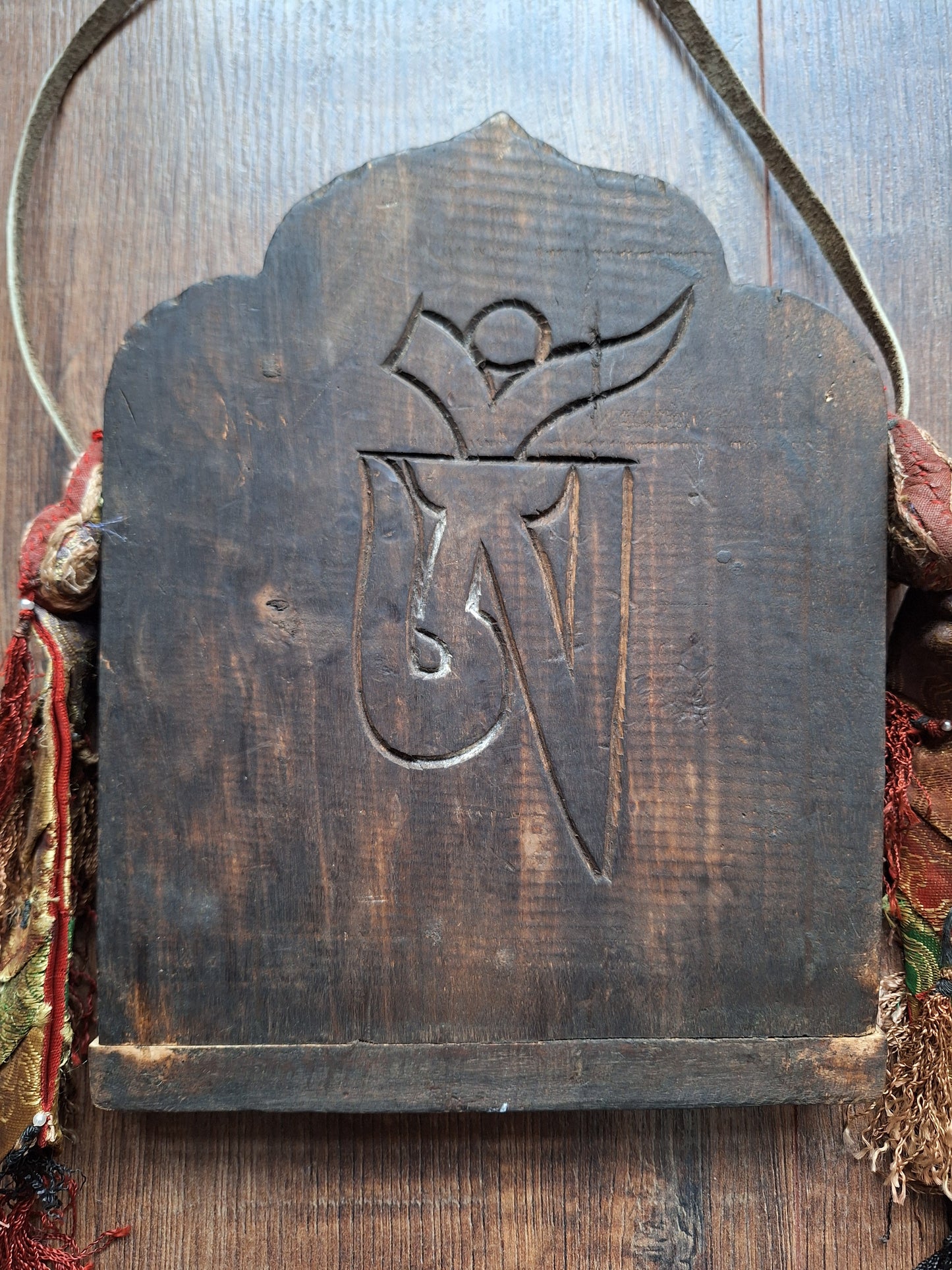
The backside is engraved with the symbol for the mantra Aum. The wallhanger can be hung with the attached leather strap. Total weight is 549 grams.
This wallhanger is from vintage origin and shows some minor signs of its age and previous usage, but overall it is in very good condition. Only one available.